Let's cut to the chase. U.S. university accreditation isn't just a fancy seal on a website. It's the fundamental quality control system for American higher education. Without it, your degree might be worth less than the paper it's printed on. I've seen too many students, both domestic and international, make costly mistakes because they didn't understand this system. They got lured by low prices or fast degrees, only to find out later their credits wouldn't transfer and their diploma was useless for jobs or further study.
The U.S. Department of Education doesn't directly run or approve universities. Instead, it relies on independent accrediting agencies to do the vetting. Think of these agencies as the Underwriters Laboratories (UL) for colleges—they test and certify that the institution meets minimum standards for things like faculty qualifications, student services, financial stability, and academic rigor.
Navigate the Accreditation Maze
The Two Main Types of Accreditation: Regional vs. National
This is where most confusion starts. Many people think "national" sounds more prestigious. In the U.S., it's usually the opposite for traditional academic degrees.
Here's the simple rule: For bachelor's, master's, and doctoral degrees in liberal arts, sciences, business, and engineering, regional accreditation is the gold standard. For vocational, technical, or faith-based institutions, national accreditation might be the appropriate and recognized path.
The table below breaks down the critical differences. This isn't just academic nuance—it affects your life.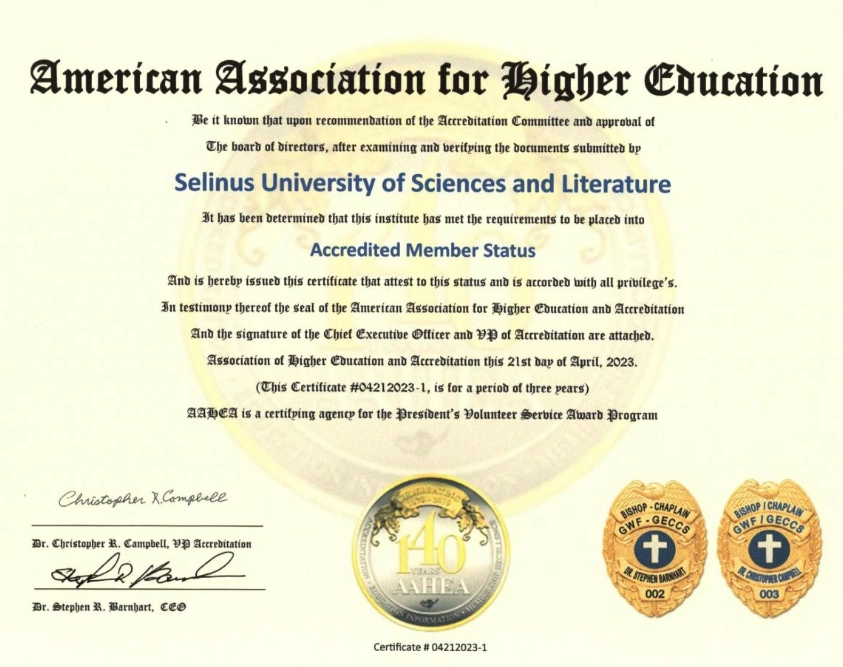
| Feature | Regional Accreditation | National Accreditation |
|---|---|---|
| Primary Focus | Traditional, comprehensive colleges and universities. Academic rigor and broad-based education. | Career-oriented, vocational, technical, or religious institutions. Specific trade skills and training. |
| Scope & Prestige | Considered the most prestigious and widely accepted form. The benchmark for academic quality. | Less prestigious in academic circles. Focus is on job readiness for specific fields. |
| Credit Transfer | Credits almost always transfer between regionally accredited schools. This is huge if you change schools. | Credits rarely transfer to regionally accredited schools. Transfer is usually only possible between nationally accredited institutions. |
| Examples of Agencies | Middle States Commission on Higher Education (MSCHE), WASC Senior College and University Commission (WSCUC). | Accrediting Commission of Career Schools and Colleges (ACCSC), Distance Education Accrediting Commission (DEAC). |
| Best For | Students seeking a broad education, planning on graduate school (law, medicine, PhD), or who may transfer. | Students seeking specific career training (e.g., cosmetology, HVAC, medical coding) in a shorter timeframe. |
I once advised a student who completed an associate's degree at a nationally accredited tech school. He wanted to pursue a bachelor's in business at a state university. They accepted only 6 of his 60 credits. He had to start almost from scratch. That's a year and thousands of dollars down the drain.
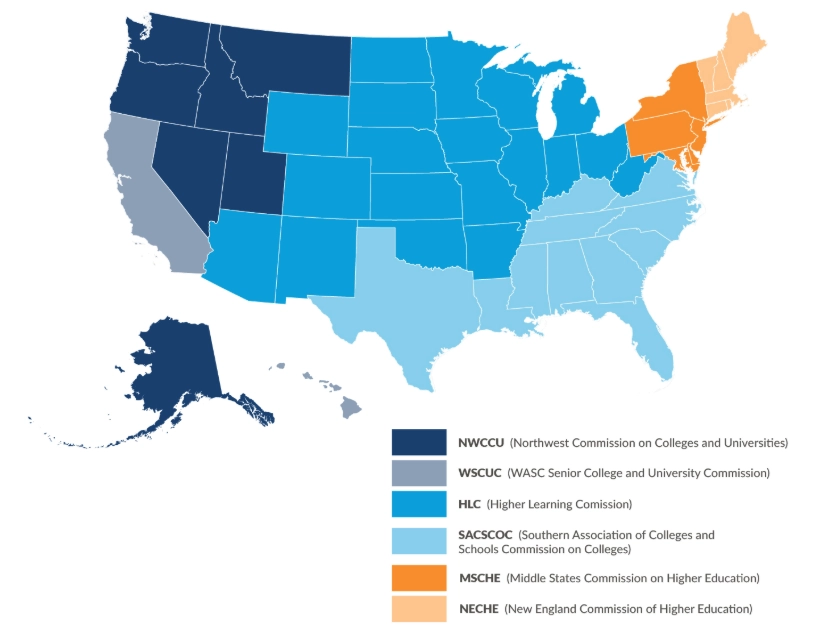
The Six Regional Accrediting Bodies (Memorize This)
There are only six. If a school claims regional accreditation, it must be from one of these. Check their official websites.
- Middle States Commission on Higher Education (MSCHE): Covers Delaware, District of Columbia, Maryland, New Jersey, New York, Pennsylvania, Puerto Rico, U.S. Virgin Islands.
- New England Commission of Higher Education (NECHE): Connecticut, Maine, Massachusetts, New Hampshire, Rhode Island, Vermont.
- Higher Learning Commission (HLC): A massive region: Arizona, Arkansas, Colorado, Illinois, Indiana, Iowa, Kansas, Michigan, Minnesota, Missouri, Nebraska, New Mexico, North Dakota, Ohio, Oklahoma, South Dakota, West Virginia, Wisconsin, Wyoming.
- Northwest Commission on Colleges and Universities (NWCCU): Alaska, Idaho, Montana, Nevada, Oregon, Utah, Washington.
- Southern Association of Colleges and Schools Commission on Colleges (SACSCOC): Alabama, Florida, Georgia, Kentucky, Louisiana, Mississippi, North Carolina, South Carolina, Tennessee, Texas, Virginia.
- WASC Senior College and University Commission (WSCUC): California, Hawaii, Guam.
Why Accreditation is a Non-Negotiable for Your Future
You might think, "I just want the knowledge; I don't care about the paper." That's a noble thought, but the real world does care about the paper. Here’s what hinges on proper accreditation.
Federal Financial Aid: This is the big one. Only students at institutions accredited by an agency recognized by the U.S. Department of Education are eligible for federal student loans and grants. No accreditation? You're paying 100% out of pocket. The Federal Student Aid website is very clear on this.
Student Visa (F-1/M-1): U.S. Citizenship and Immigration Services (USCIS) requires international students to be enrolled in a Student and Exchange Visitor Program (SEVP)-certified school. While not every accredited school is SEVP-certified, virtually every SEVP-certified school is accredited. It's a foundational requirement. Attending an unaccredited school can jeopardize your visa status.
Credit Transfer: As we touched on, this is a minefield. Life happens. You might move, change your major, or want to pursue a higher degree. If your credits aren't from a properly accredited school, they're likely stuck there forever.
Graduate School Admissions: Reputable graduate programs (MBA, MA, MS, JD, MD, PhD) will not accept a degree from an unaccredited institution. Many are also hesitant about degrees from nationally accredited schools for academically-focused programs.
Employer Recognition: Most HR departments and background check companies verify degree accreditation. A degree from a diploma mill can be grounds for rescinding a job offer or even termination for cause if discovered later.
Professional Licensure: Want to be a nurse, engineer, teacher, or accountant? State licensing boards require your degree to be from an accredited program, often specifically from a regionally accredited institution.
How to Verify a University's Accreditation Status (Step-by-Step)
Don't trust the school's own marketing. Verify it yourself. It takes five minutes and can save you years of regret.
Here's my foolproof method.
Step 1: Check the School's Website. Look for an "Accreditation" page, usually in the "About Us" section. They should name the specific agency and provide a link to its website. If it's vague ("nationally accredited") or boasts about accreditation from an unrecognized body (like the "Worldwide Online University Accreditation Council"), that's a major red flag.
Step 2: Verify with the Accreditor. Go directly to the accrediting agency's website. Every legitimate agency has a publicly searchable database of member institutions. For example, use the CHEA Directory or the U.S. Department of Education's Database of Accredited Postsecondary Institutions and Programs (DAPIP). Search for the school by its exact legal name.
Step 3: Check for "Probation" or "Warning" Status. Accreditation isn't forever. Schools can be placed on probation if they fail to meet standards. This is serious. The accreditor's database will show the current status (e.g., "Accredited," "Accredited on Probation"). A school on probation is at risk of losing accreditation, which could strand current students.
Step 4: Confirm SEVP Certification (International Students). Use the ICE SEVP School Search Tool. If the school isn't listed here, it cannot issue I-20 forms for F-1 visas.
Critical Warning: Beware of "accreditation mills." These are fake agencies that sell accreditation to any school that pays. Always cross-reference the accreditor with the lists maintained by the Council for Higher Education Accreditation (CHEA) or the U.S. Department of Education. If the agency isn't recognized by one of those two bodies, its accreditation is meaningless.
Common Pitfalls and Red Flags You Must Avoid
After years in academic advising, I've seen the same traps catch students repeatedly.
The "All Accreditation is Equal" Myth. This is the most dangerous one. A for-profit trade school might be legitimately nationally accredited, but that doesn't make its degree equivalent to one from a regionally accredited university for academic purposes. Know your goal.
Programmatic vs. Institutional Accreditation. A university can be institutionally accredited (the whole school), but a specific program within it (like its nursing or engineering program) might also have separate, specialized "programmatic" accreditation. For licensed professions, programmatic accreditation is often mandatory. Always check both.
Accreditation "Pending." This is not accreditation. It means the school has applied. Never enroll based on a promise of future accreditation.
Too Good to Be True Offers. "Earn your bachelor's degree in 12 months with no classes!" "Life experience credits!" These are hallmarks of diploma mills. Legitimate accreditation requires demonstrated coursework and academic engagement.
Reliance on "State Approval." A school being licensed to operate in a state is NOT the same as being accredited. It's a bare-minimum legal requirement, not a quality indicator.
Your due diligence is your best defense.
Your Accreditation Questions Answered
 The bottom line is this: U.S. university accreditation is the bedrock of educational quality and value. It's not just bureaucracy; it's your guarantee that your investment of time, money, and effort will yield a legitimate, recognized credential. Do the verification work upfront. It's the most important research you'll do before enrolling anywhere.
Reader Comments